

Picture a solo creator today. She is an Android developer who has built a decent app on Play Store. To turn her expertise into income, she also needs a newsletter to keep her audience updated, a payment processor to collect subscription money, a video platform to teach a course, a separate site to showcase her portfolio, and a contacts tool to build her mailing list from scratch. Five tools. Five logins. Five separate bills. Five places where her data lives in silos that do not talk to each other.
Now here is the part that should make Google uncomfortable. Every single one of those five tools already has an equivalent sitting inside Google’s own product lineup. Google Sites. Google Pay. YouTube. Blogger. Google Contacts. Google Analytics. Play Store. Gemini. All owned by the same company, all built on the same infrastructure, and all currently operating as unconnected islands instead of one unified path for creators.
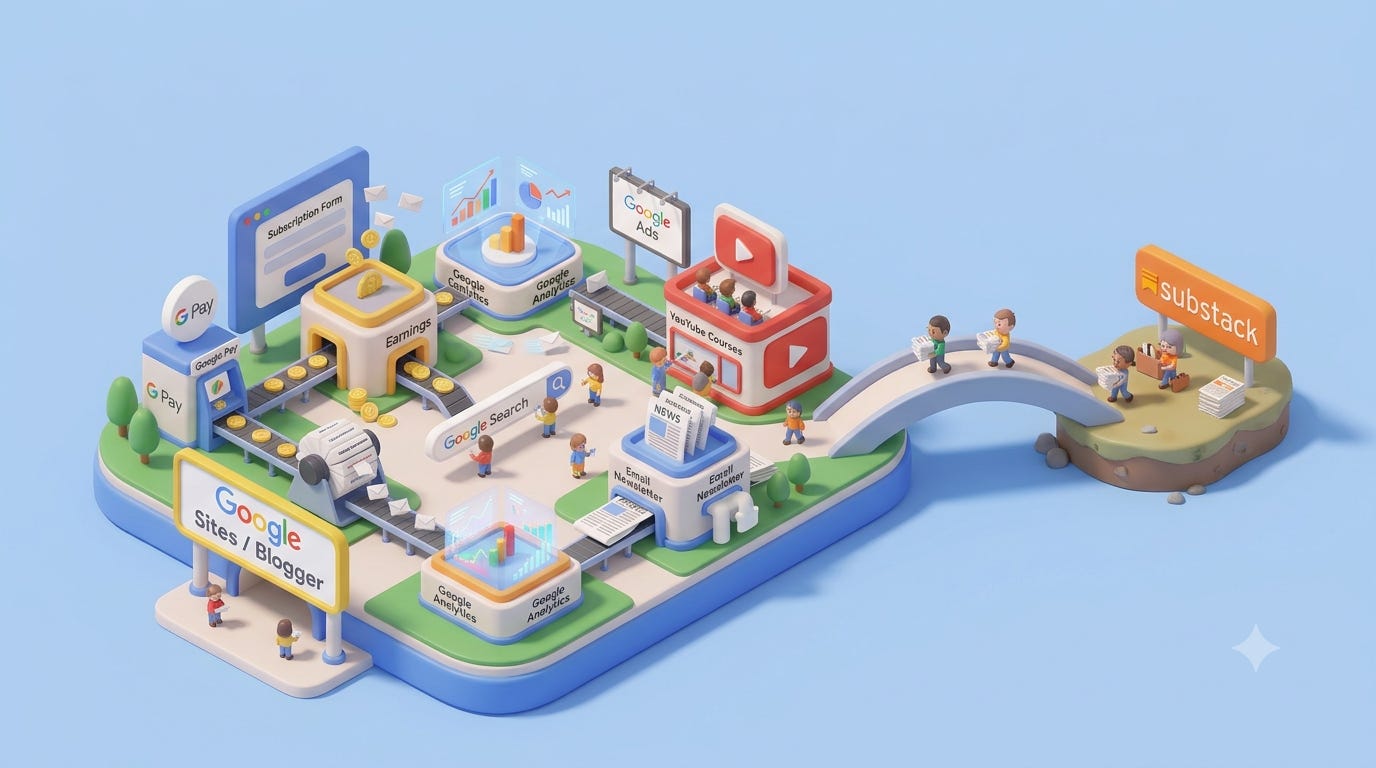
This article makes one argument. Google does not need to invent anything new to compete with and eventually overtake Substack. It simply needs to connect what it already owns.
The Core Thesis
Substack succeeded by giving independent writers one simple promise. Publish for free, pay only when you earn. That promise built a business worth talking about, but it also left enormous gaps that Google is uniquely positioned to fill, provided it stops treating its products as separate departments and starts treating them as one creator ecosystem.
No competitor, including Substack itself, can match the breadth Google already owns. The question is not whether Google has the pieces. The question is whether Google will ever bother assembling them.
Substack’s Real Pain Points
Before arguing what Google should do, it is worth being precise about what Substack actually costs its creators today.
The fee stack compounds against you as you grow. Substack takes 10 percent of subscription revenue. On top of that, Stripe charges roughly 2.9 percent plus 30 cents per transaction, along with a small recurring billing fee. Add it all up and creators are typically losing 13 to 16 percent of their gross revenue, with no volume discount as they scale. In fact, the better a creator performs, the more expensive the platform becomes, since there is no loyalty tier or reduced rate for high earners.
The real money adds up fast. A creator earning around 5,000 dollars a month in subscription revenue is paying close to 650 dollars a month in combined fees. A creator who crosses 1,000 paid subscribers can lose roughly 6,000 dollars a year to fees alone. That is not a rounding error. That is a second rent payment, gone every single month, forever, as long as the creator stays on the platform.
There is no room to sell a course. Substack only supports subscriptions. A creator cannot sell a onetime course, a template pack, or a digital product natively on the platform. This forces creators to bolt on third party tools just to diversify income, which fragments the very audience relationship Substack was supposed to simplify.
Trust has taken hits over the years. Substack has faced public criticism over its content moderation policies and has also dealt with security incidents involving user data. None of this is fatal on its own, but it adds to a growing list of reasons creators are willing to consider alternatives if a credible one appears.
Analytics, contact import, and native promotion remain weak. Substack gives creators a subscriber list and some basic metrics, but nothing close to the depth of a proper analytics suite. There is no built in way to pull in an existing contact list from another ecosystem, and there is no native paid promotion engine to help a new newsletter get discovered beyond Substack’s own recommendation network.
The Google Ecosystem Play
Here is where the opportunity becomes obvious. Imagine the same five gaps, but each one filled by a Google product the creator is often already using.
The developer. He hosts his Android app on Play Store, builds a companion site on Google Sites under his own custom domain, sells an advanced development course on YouTube, and links a newsletter on the same site to notify buyers of new releases. One login. One audience. One dashboard.
The photographer. Her portfolio lives inside Google Photos, directly embedded on her Sites page with zero third party hosting required. She sells editing masterclasses on YouTube and print orders through the same connected storefront.
The culinary expert. A recipe blog on Sites or Blogger, cooking classes sold through YouTube, and downloadable meal plans distributed through the same payment gateway that powers the newsletter subscriptions.
The musician. Production and mixing courses on YouTube, a fan newsletter and merchandise store on Sites, all branded under one custom domain purchased through Google itself.
The fitness coach and the language tutor. Workout programs or lesson packages sold through YouTube, progress tracking or practice material delivered via newsletter, and client bookings handled through the same integrated site.
The pattern repeats across every vertical. One login instead of five. One payment gateway instead of a patchwork of processors. One analytics dashboard instead of stitching together data from three different tools. One audience that Google already understands better than anyone else on the internet.
The Infrastructure Advantage
Gemini can make rapid site deployment realistic for non technical creators. Instead of spending days on layout and SEO structure, a creator could describe what they want and have a functional, search optimised site ready in minutes.
Google Pay and Play Billing already run at massive scale. While no official fee number exists for this kind of bundled creator product, it is reasonable to argue that payment rails Google already operates for millions of transactions daily make a lower blended fee plausible, especially when compared against Substack’s stacked cost of 13 to 16 percent.
Domain selling folded into the same flow means a creator can register, connect, and brand their site without ever leaving the Google ecosystem or dealing with a third party registrar.
Contacts, Analytics, and Search ads close the final loop. Instant list building from an existing Google Contacts account, unified tracking across the site, the newsletter, and the YouTube channel, and native paid promotion directly through Google Search, without needing a separate ad platform at all.
Addressing the Skeptic
Any argument this ambitious deserves to be challenged honestly, so let us do that.
“Google kills products, why would this be any different.” It is true that Google has a well known habit of shutting down beloved products, and Google Plus, Google Reader, and Currents are the usual examples people bring up. But look closely at Blogger and Google Sites specifically. Both have survived for well over two decades, largely without major investment, and are still running today with no shutdown announcement in sight. Over 353,000 websites still run on Blogger according to independent tracking data. The honest reading of that survival is not neglect, it is proof that a product does not need constant new features to stay alive if it already works and has a real user base depending on it. Now layer on the argument that matters most here. This proposed integration ties Sites and Blogger directly to YouTube and Play revenue. That gives Google an actual financial reason to protect and maintain the product, unlike Google Plus or Reader, which never had a direct revenue relationship tying them to the rest of the business.
The August 2026 Blogger suspension incident. In early August 2026, an automated security system on Blogger wrongly flagged a number of genuine blogs as violating Google’s malware policy. Most were later restored, though the episode did shake some creators’ confidence in the platform. This is not a sign that Google plans to shut Blogger down. It is a sign that its moderation systems need better oversight. That is exactly why revenue linked integration matters. Once Blogger and Sites are tied to YouTube and Play earnings, Google has real financial reason to fix such issues quickly, the way it already protects Search and Ads.
The antitrust question. Bundling this much of the creator economy into a single company’s ecosystem is not a small ask, and it would understandably invite regulatory scrutiny given Google’s existing market position in search and advertising. This piece is not the place to resolve that debate, but it would be dishonest to leave it out entirely. Any real version of this plan would need to be built with that scrutiny in mind from day one.
The Real Question
Every piece Google needs is already sitting inside its own portfolio. Sites, Blogger, Gemini, YouTube, Analytics, Search, Contacts, Photos, and Play are not five different products waiting for five different roadmaps. They are one obvious ecosystem waiting for someone inside Google to connect the dots.
So the real question is not whether Google can beat Substack. On paper, it clearly can, and probably in a single coordinated move rather than a slow multi year rollout. The real question is whether Google, a company that has historically treated its own products as isolated silos rather than as one connected platform, will ever choose to build it.
If it does, Substack will have a serious problem on its hands. If it does not, this remains one of the more interesting blind spots in the entire creator economy today, sitting in plain sight, fully assembled, and completely unused.