

We waited years for tools that could take care of our small chores. Now we have them, and a lot of us use them to make pictures of ourselves as action figures. It is fun for a minute, and then it takes us nowhere.
That is partly because nobody has handed us much else. What companies are handing us is a chatbot inside every app, each one built to keep us inside.
The problem: a walled garden in every app
Many companies add a chat icon in the corner and call it an AI strategy. It waits for you to type, and it works only inside that one app. Ten apps means ten assistants, and none of them knows the others exist. Your fridge does not know your calendar, and your calendar does not know your cab.
Here is the test I would apply to any AI feature:
Did this give the user time back, or take it away?
An assistant that keeps me stuck in one app takes time away. The better idea is to build for the assistant I already carry.
The better way: open your product to my assistant
Every phone now has an assistant, whether Siri, Gemini or something else. Suppose I say, “Hey Siri, book me a cab with Uber from here to the airport.” Today, it may just open the Uber app and leave the rest to me. In future, the app should share what it can do, such as check fares, book and track a ride, through APIs or open standards like MCP. The assistant then does the work, with my permission, and says, “Your cab arrives in four minutes.”
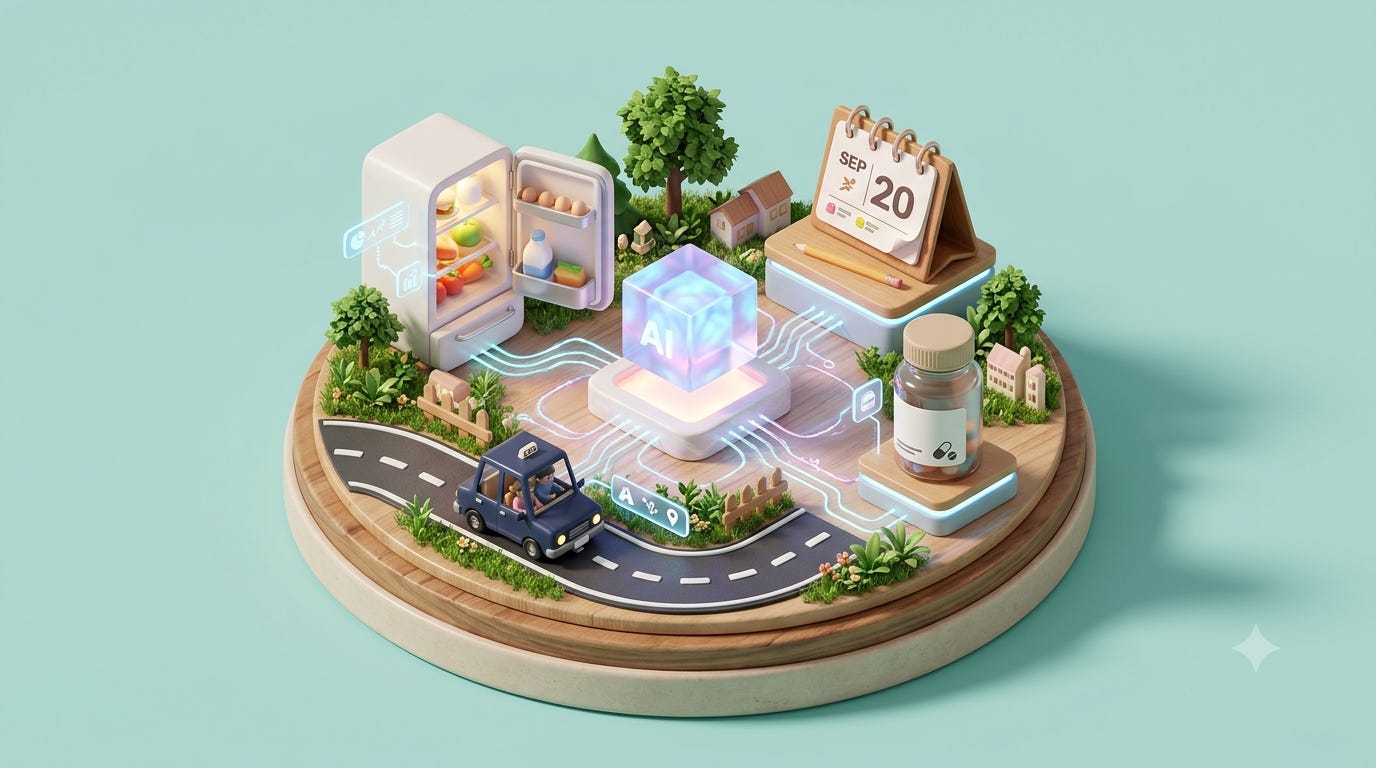
This has already begun. Swiggy lets people order food and groceries through ChatGPT, Claude and Gemini. Android’s AppFunctions and Apple’s App Intents are ways for apps to plug into phone assistants. It is early and uneven, but the direction is clear.
Companies can keep their own in app assistants. The problem is only when that is the sole door. Open the front door as well.
Home and food: the fridge that thinks before you shop
Imagine your refrigerator checks its own contents on the device, without sending photos of your kitchen anywhere. It knows the eggs are finished and the milk expires tomorrow. It asks: “Do you want these delivered, or would you rather go and pick them up?”
If you choose delivery, it builds the basket on Instamart or any app you prefer, and you approve it in one tap. If you prefer to go in person, the assistant becomes a planner:
With your partner: it checks their calendar, only if they have agreed, and shows just the free slots, not the meeting details.
With the kids: it adds a kid friendly cafe or park near the store.
Your choice: you can ask for the nearest organic store or the best rated one, even if farther. Your neighbourhood kirana should show up too, not only the big chains.
The AI does not decide for you. It removes the searching and the back and forth, and leaves the choice with you.
What changes for companies: grocery apps and fridge makers should let assistants check stock, build a basket and place an order, and a fridge should work with any grocery app the user picks.
Health: helpful and humble
Apollo, PharmEasy and MedPlus hold a lot of useful context that mostly goes unused. An AI native version could:
Refill before you run out: “Your BP tablets have 4 days left. Shall I order now?” It should reorder only what a valid prescription allows.
Flag interactions: if two doctors prescribe different medicines, it tells you to check with your chemist or doctor before taking both.
Look after parents from a distance: a family member is told about a missed dose only if the parent has agreed, and it must be easy to switch off.
The rule is simple: AI informs, professionals decide. A wrong grocery order is an annoyance. A wrong medical suggestion can be dangerous. So AI should never diagnose or change doses on its own.
What changes for companies: pharmacies should let assistants read refill status, order and track delivery, with strict consent, prescription checks and the tightest permissions of all.
Getting around
Uber, Ola and Rapido know your routine, yet they still wait for you to open the app and type a destination.
Daily commute: it pre books your ride and warns you, “It is raining and there is a cricket match near the stadium. Leave 15 minutes earlier.”
Cab sharing: it can suggest people travelling your route, but only with verified profiles, women only options and clear opt in, within local rules.
Other cities and countries: tell it “I need to be in Bengaluru next Friday,” and it compares flight, train, bus and cab by door to door time and cost, books the airport cab and adjusts your meetings if the flight is delayed. For a trip abroad, it prepares a checklist for visa, forex and connectivity, with links to official sources.
A morning that works. You say, “Book me a cab tomorrow at 9 AM.” Next morning, you oversleep. Instead of a panic, the assistant rings a louder alarm that you had allowed, sees a meeting the moment you reach office, books a cab for right now and offers to tell the attendees you will be a few minutes late. You just get up and go.
What changes for companies: cab, airline, railway and bus apps should let assistants get fares, book, reschedule, cancel and share live status.
The glue: messages, mail and calendar
Gmail can summarise a long thread and pull out the deadline. WhatsApp can turn a 300 message group chat into three lines: what was decided, what is pending and who owes what. Messages can warn you about scam links and fake bank alerts before you tap, which in India alone would save real money. Calendar can add buffers and reschedule when something changes.
What changes for companies: offer clear, permission based actions such as “read this thread” or “send this reply after I approve,” and let users decide what the assistant can see and do, app by app.
The new deal: first mile and last mile
Here is the model I would like companies to think about.
The assistant does the first mile: finding, comparing and helping the user decide. Your app does the last mile: payment, tracking, loyalty and support.
If your price or service is better, the assistant can say so and take the user straight to a simple pay screen in your app. You do not need to trap anyone. You only need to win the recommendation.
This works only if a few things are true:
Prices are honest. The comparison shows the final price with all fees.
The handoff is light. No banners and upsells between the user and the payment step.
Payment is smooth. Today, orders placed through AI tools on Swiggy support only cash on delivery, so this is the hardest step. A secure handoff to UPI in your own app is a real solution.
The uncomfortable parts
Money. Apps earn more when we browse longer, and comparison can squeeze margins. But trust and loyalty last longer than impulse orders.
New gatekeepers. The OS company can become the new walled garden if it favours its own apps or takes a hidden cut. Users should be able to choose their assistant, and recommendations should be explained.
Privacy and security. These ideas need deep access to data, so keep processing on the device where possible, follow India’s DPDP Act, and ask for confirmation before money, health or sharing data. Every open door is also a target for scammers.
Time and access. Integrating thousands of apps will take years, which is why it is worth starting now. Voice and regional languages are essential for India, and small shops need an easy way to be found without building their own APIs.
A fair counterargument. Creative AI is not always slop, and it lets many people make things they never could. My point is about balance. Everyday usefulness is still deeply underexplored.
A note to companies, builders and OS makers
This is not a demand. It is a hope.
The real keys are with the companies that make our apps, the builders who ship them and the OS makers who decide what every app is allowed to do. I hope you will think along these lines on your own, rather than waiting for a regulator or a competitor to push you.
Companies, open your products to assistants through APIs or MCP, with proper permissions.
Compete on the outcome, not on lock in.
OS makers, be the bridge, not the toll booth. Use open standards and let users choose their assistant.
Keep recommendations fair, and explain why something is suggested.
Measure time saved, not time spent.
Build for Bharat, with voice, regional languages and modest phones.
Here is a small exercise. Pick one product you own or use, list the manual steps for one job, and ask which of them an assistant could do if you opened the door. Then open one this week.
The choice in front of us
We can spend these tools on memes, or on giving people back their time, health and peace of mind. My hope is that companies choose to open the door, not lock it.
🧠 Human driven, AI assisted. The perspectives shared in this newsletter are my own, refined and structured with the help of Large Language Models.