

India has always been slow to bring big technology into everyday government systems. Its people, however, are a completely different story — we’ve consistently been among the fastest in the world to adopt new technology.
Look at the internet and social media boom. The adoption rate was staggering. Affordable smartphones, and Jio’s free internet offer in 2016, were game changers. That single move shocked not just Indian telecom players but the entire world. Within months, nearly every household had at least one Jio SIM card — that’s the scale of impact we’re talking about.
The Telecom Boom That Changed Everything
Once cheap data became the norm, tech companies saw their opening. A flood of affordable smartphones and new apps followed, making online communication and collaboration easier than ever. And the cheaper the access, the more time people spent online.
Around the same time came another turning point: demonetisation. It completely reshaped how India made payments. The government’s BHIM app was a simple but brilliant starting point — lightweight, straightforward, and the first exposure many Indians had to digital payments. Soon after, private startups built their own UPI-based apps, and the digital payments ecosystem exploded into what it is today.
The Great Indian App Fragmentation
Here’s the real point: when new technology becomes widely accessible, it hands everyone — startups and governments alike — the ability to build. And that’s exactly what happened in India. Every state government launched its own apps and websites for citizens: one for electricity, one for gas, one for transport, one for industries, and so on. As the app boom continued, most of these services split off into their own standalone mobile apps.
And here’s the amusing part — every time a new government comes to power, a few months later, “new” versions of the same old apps mysteriously appear. Same functionality, a slightly different design, and of course, a fresh photo of the new Chief Minister on the home screen.
The scale of this fragmentation is easy to underestimate until you actually try to use it. Move from Delhi to Bengaluru, and you’ll find yourself downloading an entirely new electricity app, a new gas-booking app, and a new transport app — each with its own login, its own interface, and its own quirks. Multiply that across 28 states and 8 union territories, and you get a citizen experience that resets every time you cross a border.
The Missing Piece: A True Super App
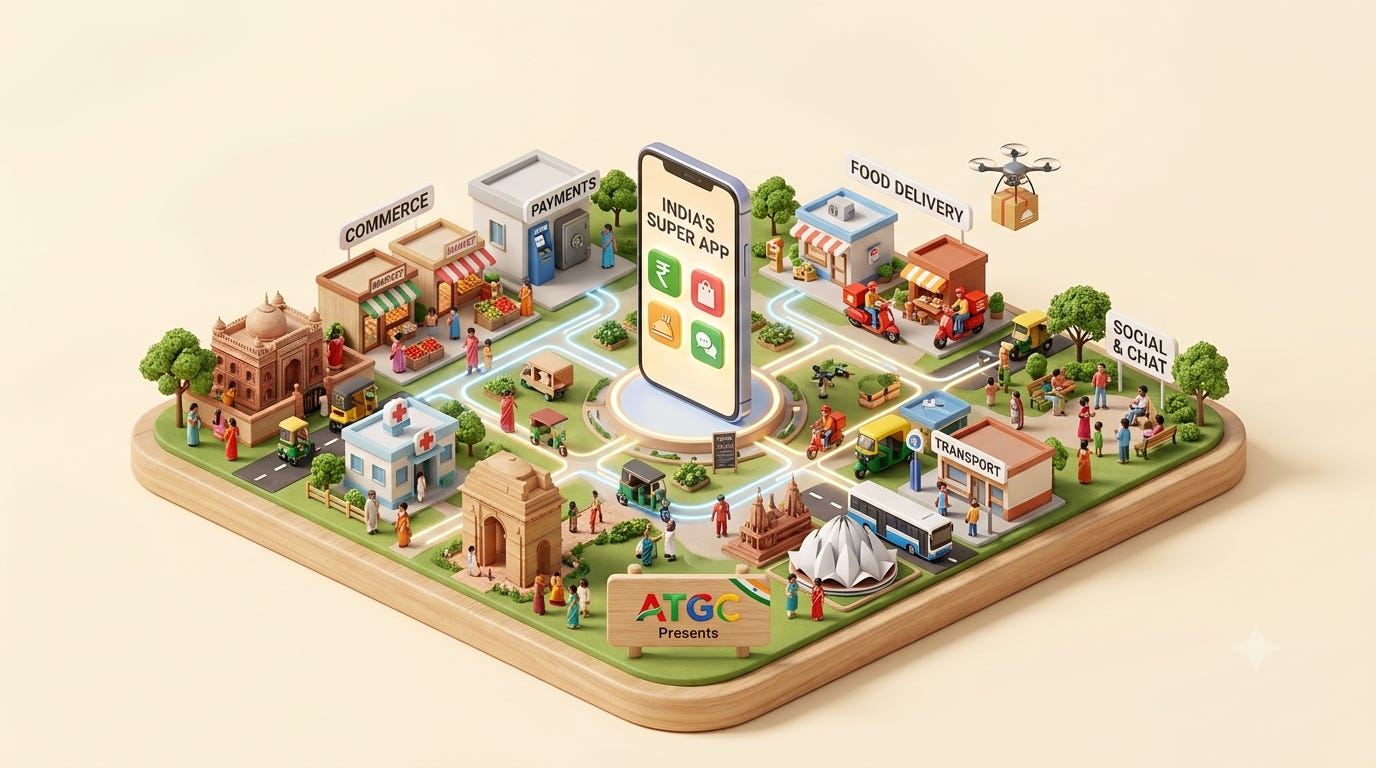
What hasn’t evolved is this: no one — not the central government, not any state government — has attempted to bring these services together into a single, unified “super app.” And I’m not only talking about government services. Imagine one app that handles everything: booking cabs and flights, ordering food and medicine, paying bills, and more.
A few players have tried. Paytm and Tata Neu both made attempts, but neither has fully cracked it. Meanwhile, we keep seeing headlines about state governments banning or restricting ride-sharing apps like Ola, Uber, or Rapido following local protests — with some states even launching their own short-lived alternatives to calm things down. These are patches, not solutions.
So Why Hasn’t This Happened Yet?
It’s worth asking why, given all the pieces are already in place, no one has actually built this. A few reasons stand out:
No single owner. Government services fall under different ministries and state departments, each with its own budget, vendor, and priorities. There’s no one body mandated to own a unified citizen-facing platform.
Political incentives run the other way. A state-branded app — complete with the ruling party’s face on the splash screen — is a visibility tool. A shared, neutral, cross-state platform offers no such political payoff.
Data privacy and trust concerns. Merging identity, location, payments, and service history into one app raises real questions about who controls that data and how it could be misused.
Interstate friction. Transport and ride-sharing regulations differ by state, and local politics around gig-economy jobs (as seen in the recurring Ola/Uber/Rapido bans) make a single national experience harder to standardize.
None of these are insurmountable, but together they explain why the technology has existed for years while the product hasn’t.
Why Should a State Border Decide Which App I Use?
Think about it from an ordinary user’s perspective: should we really need to install a new app every time we cross into a different state? That makes no sense. Part of why Uber works so well globally is consistency — you can land in any city on earth, open the same app, and it just works. Why can’t India offer that same experience?
We already have the foundation for it: Aadhaar, a universal digital identity that could easily plug into a unified system. Imagine a single app that lets you:
Book your gas cylinder
Pay your electricity bill
Recharge your phone
Order food or medicine
Book a flight or train ticket
Use the metro or local buses
One app. Every service. Anywhere in India. Built in with a secure digital locker for your documents and a wallet for instant payments. Apps like Paytm, PhonePe, CRED, Tata Neu, and even Ola already have much of the underlying infrastructure needed. The real question is: who’s willing to take the leap?
What Malaysia’s Grab Taught Me
Last year, I visited Malaysia to meet a friend, and I was genuinely blown away by the Grab app. It handled everything — rides, deliveries, food, and payments — all from one place. As a first-time visitor, I didn’t need to ask anyone for help navigating the city; everything simply worked.


Coming back to India, I couldn’t stop thinking: why don’t we have something like this yet? Years later, we still haven’t taken a real step in that direction.
this isn’t just a Malaysia story. China’s WeChat folded messaging, payments, ride-hailing, and government services into a single “everything app” years ago. Indonesia’s Gojek did much the same, evolving from a motorbike-taxi app into a full super app for an entire country of over 270 million people. If two very different economies in our own region have managed this, the excuse that India is “too big” or “too complex” starts to look thin.
The Case Against a Super App
To be fair, a single unified app isn’t without risk. Concentrating rides, payments, identity, and government services into one platform creates a single point of failure — an outage takes down everything at once, not just one service. It also raises monopoly concerns: whoever builds and owns this app would hold an enormous amount of power (and data) over how citizens access basic services. And a major breach wouldn’t just leak your chat history — it could expose your identity, your finances, and your location in one shot.
These aren’t reasons to abandon the idea, but they are reasons to get the governance right before the technology — clear data ownership rules, strong security standards, and probably some form of public oversight, rather than a single private company holding all the keys.
The Way Forward
Building a super app of this scale isn’t a job for tech companies alone. Central and state governments need to collaborate too, looking beyond short-term politics toward long-term impact for citizens. Once a unified system exists, details like revenue-sharing and service charges will sort themselves out. What matters most is building one seamless digital experience that makes every Indian’s life simpler, faster, and more connected.
So here’s the question I keep coming back to: if you could design India’s super app from scratch, what would you want it to do first — and who would you trust to build it?
🧠 Human driven, AI assisted. The perspectives shared in this newsletter are my own, refined and structured with the help of Large Language Models.